Sunday, January 1, 2012

The Isaiah 53 Controversy


I tend to avoid Biblical arguments when I present a positive case for my position, because I believe that arguments from Biblical interpretation have this nasty tendency toward anachronism. It is too easy to inject our understanding of history into our interpretation of prophecy, while the original audience did not possess the historical hindsight that we possess today.

However, I have been watching anti-missionary videos on YouTube. Isaiah 53 is the most common subject that they discuss. I have noticed two trends among them:

1. They almost always attribute the role of the suffering servant to national Israel.
2. They all seem to use the same arguments.

This makes me wonder how well they know Isaiah. Have they done any actual research into the subject, or are they just repeating the same arguments from the anti-missionary playbook? I fear it is the latter.

Of all the books in the Tanakh, I think Isaiah deserves the award for "most negative portrayal of national Israel." More about this when I start reading passages from the relevant sections. The section of Isaiah that supplies the context to Isaiah 53 is what scholars call "Deutero-Isaiah" which comprises Isaiah 40-55. The style and topics change so dramatically when we hit Isaiah 40, that skeptical scholars believe (wrongly) that this section was written by a different author.

Isaiah 40-55 deals with God's relationship to Israel. Themes include:

1. There is no God but Yahweh
2. God is sovereign over all creation
3. [Ancient] Israel was chosen as God's servant, but has become evil
4. God will chastise [Ancient] Israel, but then restore the nation
5. The righteous remnant should not lose hope
6. God's righteous servant will restore Israel

And it's this last point that the anti-missionaries cannot get right. National Israel, as portrayed in the book of Isaiah, is in no position to suffer innocently for the sins of anyone else.

Ancient Israel had a difficult history. The book of Judges portrays Israel as a nation in a downward spiral where Israel falls into idolatry and apostasy. A judge comes and restores Israel, which is restored somewhat, and the cycle begins anew. Another apostasy, another judge. Eventually, the people of Israel anoint Saul as king. He does fine for a while, then turns evil. David then becomes king, but still arranges for the murder of Uriah the Hittite. Solomon starts out well, but later also falls into apostasy and idolatry.

The kingdom is then divided into the northern kingdom of Israel and the southern kingdom of Judah. Northern Israel falls into immediate apostasy with Jeroboam and never recovers. All of Israel's kings are apostate, and Israel is wiped out by Assyria in 722 BCE. The Southern kingdom of Judah has 20 kings: 8 are righteous and 12 are apostate. Judah's widespread idolatry was catching up with Judah, and this is where Isaiah comes in. Northern Israel is already dead. Judah faces the very real possibility of exile. Isaiah's job is to warn the people of Judah to return to God and to abandon idolatry. God loves his people and has great plans for them, even though they are a wicked bunch.

Here are some highlights from Deutero-Isaiah. I do recommend reading the whole section in its entirety, though.

Comfort, comfort my people, says your God.
Speak tenderly to Jerusalem,
and cry to her
that her warfare is ended,
that her iniquity is pardoned,
that she has received from the LORD's hand
double for all her sins.
(Isaiah 40:1-2)

This is an important theme throughout this section. Israel has sinned severely, and needs to be reminded that even though that God loves Israel, even though he punishes the nation.

But you, Israel, my servant,
Jacob, whom I have chosen,
the offspring of Abraham, my friend;
you whom I took from the ends of the earth,
and called from its farthest corners,
saying to you, “You are my servant,
I have chosen you and not cast you off”;
(Isaiah 41:8-9 ESV)

This is the first mention of national Israel as God's servant. Notice that Jacob, Israel, and the offspring of Abraham are three ways of describing national Israel. The "you" here in Hebrew is singular in both verses.

Behold my servant, whom I uphold,
my chosen, in whom my soul delights;
I have put my Spirit upon him;
he will bring forth justice to the nations.
He will not cry aloud or lift up his voice,
or make it heard in the street;
a bruised reed he will not break,
and a faintly burning wick he will not quench;
he will faithfully bring forth justice.
He will not grow faint or be discouraged
until he has established justice in the earth;
and the coastlands wait for his law.
Thus says God, the LORD,
who created the heavens and stretched them out,
who spread out the earth and what comes from it,
who gives breath to the people on it
and spirit to those who walk in it:
“I am the LORD; I have called you in righteousness;
I will take you by the hand and keep you;
I will give you as a covenant for the people,
a light for the nations,
to open the eyes that are blind,
to bring out the prisoners from the dungeon,
from the prison those who sit in darkness.
(Isaiah 42:1-7 ESV)

The servant here is not described as Israel. Instead, the servant is called righteous, as one who will bring justice to all the nations. This servant will also bring sight to the blind. This is important because God then describes Israel as blind and deaf.
Hear, you deaf,
and look, you blind, that you may see!
Who is blind but my servant,
or deaf as my messenger whom I send?
Who is blind as my dedicated one,
or blind as the servant of the LORD?
He sees many things, but does not observe them;
his ears are open, but he does not hear.
The LORD was pleased, for his righteousness' sake,
to magnify his law and make it glorious.
But this is a people plundered and looted;
they are all of them trapped in holes
and hidden in prisons;
they have become plunder with none to rescue,
spoil with none to say, “Restore!”
Who among you will give ear to this,
will attend and listen for the time to come?
Who gave up Jacob to the looter,
and Israel to the plunderers?
Was it not the LORD, against whom we have sinned,
in whose ways they would not walk,
and whose law they would not obey?
(Isaiah 42:18-24 ESV)

Here, Israel is portrayed as both God's servant and as blind and deaf. Israel is plundered and looted because Israel had sinned against God. Israel would not walk in God's ways and would not obey God's law. This continues one of the main themes of this section of Isaiah. God is good. Ancient Israel is evil.

“Yet you did not call upon me, O Jacob;
but you have been weary of me, O Israel!
You have not brought me your sheep for burnt offerings,
or honored me with your sacrifices.
I have not burdened you with offerings,
or wearied you with frankincense.
You have not bought me sweet cane with money,
or satisfied me with the fat of your sacrifices.
But you have burdened me with your sins;
you have wearied me with your iniquities.
“I, I am he
who blots out your transgressions for my own sake,
and I will not remember your sins.
Put me in remembrance; let us argue together;
set forth your case, that you may be proved right.
Your first father sinned,
and your mediators transgressed against me.
Therefore I will profane the princes of the sanctuary,
and deliver Jacob to utter destruction
and Israel to reviling.
(Isaiah 43:22-28 ESV)

Here, God chastises Israel again for disobedience and sins. Does it look like Israel is suffering innocently for the sins of anyone else?

Remember these things, O Jacob,
and Israel, for you are my servant;
I formed you; you are my servant;
O Israel, you will not be forgotten by me.
I have blotted out your transgressions like a cloud
and your sins like mist;
return to me, for I have redeemed you.
(Isaiah 44:21-22 ESV)

God is calling sinful Israel to return to him. God will be glorified in Israel, and Israel is still God's glory, but not because of any righteousness or merit on Israel's part. This also may have an application to modern Zionism. If Israel today is the same nation as ancient Israel, then God has given the nation the right to the land, independently of what Israel does with it. Isaiah chastises Israel as an evil nation, but still says that Israel is the apple of God's eye and the nation in which God is glorified. Nothing that Israel can do will ever cause God to abandon Israel. Even if Israel were to become the most evil nation in the history of the world, God will still bless those who bless Israel and curse those who curse Israel.

Hear this, O house of Jacob,
who are called by the name of Israel,
and who came from the waters of Judah,
who swear by the name of the LORD
and confess the God of Israel,
but not in truth or right.
(Isaiah 48:1 ESV)

Israel confesses to know God, even though the nation is unrighteous.

Because I know that you are obstinate,
and your neck is an iron sinew
and your forehead brass,
I declared them to you from of old,
before they came to pass I announced them to you,
lest you should say, ‘My idol did them,
my carved image and my metal image commanded them.’
“You have heard; now see all this;
and will you not declare it?
From this time forth I announce to you new things,
hidden things that you have not known.
They are created now, not long ago;
before today you have never heard of them,
lest you should say, ‘Behold, I knew them.’
You have never heard, you have never known,
from of old your ear has not been opened.
For I knew that you would surely deal treacherously,
and that from before birth you were called a rebel.
(Isaiah 48:4-8 ESV)

God, still speaking to Israel, calls the nation obstinate and stubborn, as well as idolatrous. More importantly, God says that he does declare new things that the people have not heard. Therefore, let this put to rest any idea that God stopped delivering new revelation at Sinai. And no, Deuteronomy 12:32 is not a counter-example. In Deuteronomy, Moses is only claiming that the Pentateuch, the constitution of Israel, cannot be altered. Nor is Deuteronomy 29:29 a counterexample. Here, Moses is warning against the pagan mysticism that flourished in the ancient world. However, since the secret things belong to God, he still has the prerogative if he wanted to reveal additional information at a future date.

There is no indication that God will stop revealing new information, such as theological information, to Israel. Indeed, Isaiah shows that God does continue to reveal new information even after the death of Moses.

And he said to me, “You are my servant,
Israel, in whom I will be glorified.”
But I said, “I have labored in vain;
I have spent my strength for nothing and vanity;
yet surely my right is with the LORD,
and my recompense with my God.”
And now the LORD says,
he who formed me from the womb to be his servant,
to bring Jacob back to him;
and that Israel might be gathered to him—
for I am honored in the eyes of the LORD,
and my God has become my strength—
he says:
“It is too light a thing that you should be my servant
to raise up the tribes of Jacob
and to bring back the preserved of Israel;
I will make you as a light for the nations,
that my salvation may reach to the end of the earth.”
(Isaiah 49:3-6 ESV)

The role of this servant is to bring back Jacob and Israel. The servant is called Israel yet is distinct from national Israel. In fact, even the Rabbinic commentaries such as that of Rav Schwab, recognize that the servant in this section is not national Israel. Even the Rabbis agree that there is more than one servant in Deutero-Isaiah. Schwab himself believes that the servant of this section is Isaiah. Question is: did Isaiah bring knowledge of Yahweh to all the nations? Did Isaiah bring salvation to the ends of the earth? Not a chance. It was the followers of Jesus who were commanded to go to the ends of the earth and make disciples of every nation. This is why an era is fast approaching where people will not need to tell their neighbors about Yahweh, the God of Israel. Everyone will know him, and have the law of Yahweh written on their hearts.

Thus says the LORD:
“Where is your mother's certificate of divorce,
with which I sent her away?
Or which of my creditors is it
to whom I have sold you?
Behold, for your iniquities you were sold,
and for your transgressions your mother was sent away.
(Isaiah 50:1 ESV)

And again, Israel suffers not for the sins of the gentile nations, but for Israel's own sins, just as God had promised in Deuteronomy.

Behold, my servant shall act wisely;
he shall be high and lifted up,
and shall be exalted.
As many were astonished at you—
his appearance was so marred, beyond human semblance,
and his form beyond that of the children of mankind—
so shall he sprinkle many nations;
kings shall shut their mouths because of him;
for that which has not been told them they see,
and that which they have not heard they understand.
Who has believed what he has heard from us?
And to whom has the arm of the LORD been revealed?

For he grew up before him like a young plant,
and like a root out of dry ground;
he had no form or majesty that we should look at him,
and no beauty that we should desire him.
He was despised and rejected by men;
a man of sorrows, and acquainted with grief;
and as one from whom men hide their faces
he was despised, and we esteemed him not.
Surely he has borne our griefs
and carried our sorrows;
yet we esteemed him stricken,
smitten by God, and afflicted.

But he was pierced for our transgressions;
he was crushed for our iniquities;
upon him was the chastisement that brought us peace,
and with his wounds we are healed.
All we like sheep have gone astray;
we have turned—every one—to his own way;
and the LORD has laid on him
the iniquity of us all.
He was oppressed, and he was afflicted,
yet he opened not his mouth;
like a lamb that is led to the slaughter,
and like a sheep that before its shearers is silent,
so he opened not his mouth.
By oppression and judgment he was taken away;
and as for his generation, who considered
that he was cut off out of the land of the living,
stricken for the transgression of my people?
And they made his grave with the wicked
and with a rich man in his death,
although he had done no violence,
and there was no deceit in his mouth.
Yet it was the will of the LORD to crush him;
he has put him to grief;
when his soul makes an offering for guilt,
he shall see his offspring; he shall prolong his days;
the will of the LORD shall prosper in his hand.

Out of the anguish of his soul he shall see and be satisfied;
by his knowledge shall the righteous one, my servant,
make many to be accounted righteous,
and he shall bear their iniquities.
Therefore I will divide him a portion with the many,
and he shall divide the spoil with the strong,
because he poured out his soul to death
and was numbered with the transgressors;
yet he bore the sin of many,
and makes intercession for the transgressors.
(Isaiah 52:13-53:12 ESV)

As an aside, Tovia Singer claims in his lecture Sin and Atonement that Judaism has no concept of substitutionary atonement i.e. for one person's suffering to pay for someone else's sins. This passage definitively refutes that notion Even the rabbis admit that in Isaiah 53, someone is suffering to pay for the sins of someone else. The question is: who is paying for whose sins? Who is the "we" in this passage, and who is the servant?

The first thing to notice in this passage is that the gentile kings shut their mouths because of the servant. They are not the ones speaking in this passage. Also remember Isaiah's description of Israel. The nation repeatedly receives punishment for its own sins. They did not walk in God's ways. They did not obey God's commands. Israel had been disobedient, failing to offer sacrifices at the proper time, and failing to obey God. It is because of Israel's sins that God will deliver Israel to utter destruction. The nation does not confess God in truth. Indeed, Israel is described as treacherous and deceitful. Israel is stubborn and idolatrous.

Isaiah also speaks of this other servant who will restore Jacob, bring Israel back into God's favor. This servant will restore sight to the blind nation of Israel. He will suffer repeatedly, but not for his own sins. He will be innocent, but suffer to make atonement for the sins of Israel.

Of all the possible candidates, Isaiah 53 better fits the life of Jesus than that of anyone (or anything) else. And attempts to disqualify Jesus for acts such as his clearing of the temple are nothing more than exercises in nit-picking. They give prophecy such artificially strict and narrow criteria for fulfillment, that they presume to dictate to God how he must fulfill his prophecies.

Jesus fulfilled the criteria for the suffering servant of Isaiah 53 better than any of his rivals. He was born into a lower-class family, and not initially seen as important. He acted as a prophet, calling the people of Israel to abandon their factionalism, self-righteousness, and man-centered civil religion, and instead to set their hearts on the God of Israel. He opened the eyes of the blind and healed many ailments, performing a ministry of miracles. Yet he was despised and rejected by the authorities of Israel, who became jealous of his radical views and rising popularity.

When the authorities caught him, they led him like a lamb to the slaughter. If Jesus had defended himself at the trial, he likely would have been acquitted. Yet he kept his dialogue to a minimum, and was sent to die because he refused to speak up for himself. Jesus was crushed and beaten so badly that he barely resembled the semblance of a man. He poured himself out unto death alongside other criminals in order to make atonement for the sins of humanity. He died with the wicked, but was buried by Joseph of Arimathea in an unused and extremely expensive bench tomb. Only the very rich could afford to use such tombs.

He did not stay dead, though. Jesus rose and appeared over a period of forty days to many people, including his followers, friends, and groups. He even appeared to his brother James, who was not a believer in Jesus before this point. He also appeared to Paul of Tarsus, who was sort of the first century director of Yad L'Achim, or perhaps the Tovia Singer of his era. What kind of evidence would it take to convince someone like Singer to believe that Jesus is the risen Messiah and God incarnate? That is the kind of evidence Paul had.

Thanks to the work of Jesus, the word of the God of Israel is spreading rapidly to people of every tribe and every tongue. The Bible has been translated into over 2,000 different languages. We are fast approaching a unique time in history, when you will no longer have to tell people about the God of Abraham, Isaac and Jacob, for they will already know who this God is.

Wednesday, December 28, 2011

Answering Critics: Resurrection Proves Christianity?


Recently, I saw a video by YouTuber Omedyashar (a.k.a. Yosef), a former Christian who converted to Orthodox Judaism. In his video, he responds to the following question:
"In the New Testament, Jesus' ascension into heaven was witnessed by many people. As you place great emphasis on the importance of witnesses and witnessing an event as proof, for example Mount Sinai where God speaks and everybody hears, what is your understanding of how so many people may have witnessed such an event if it either did not happen or could not happen due to Jesus being a false Messiah?"
The question has a great deal of merit, but can be made even stronger. If we give secular historians the benefit of the doubt, what information can we glean about Jesus of Nazareth? I will go through three passages believed by the majority of New Testament historians to be historically authentic.

First, Jesus' claim in Matthew 11. Jesus says: "All things have been handed over to me by my Father, and no one knows the Son except the Father, and no one knows the Father except the Son and anyone to whom the Son chooses to reveal him." This passage is considered historically authentic because Jesus is claiming to be unknowable. Yet, the post-Easter church taught that you can know Jesus. Therefore, this passage is very unlikely to have been fabricated. In this passage, Jesus is claiming to have a unique relationship to the Father, superior to all of humanity, and to be the only way to know the Father.

Second, Jesus' parable of the tenants in the vineyard in Mark 12. In this parable, the landowner goes away on a long journey and leaves a group of tenants in charge. During the harvest, the owner sends a series of servants to collect payment, and each time, the wicked tenants kill the servant. Finally, the owner sends his own son to collect payment, and the tenants kill him as well. The landowner represents God the Father. The servants represent the prophets of Israel. The son represents Jesus, and the land represents the land of Israel. The point of the parable is that because of the disobedience of the people of Israel, God would strip the land from the Jews and give it to the gentiles, at least for a time. In this parable, Jesus portrays himself as superior to all the prophets.

Third is Jesus' saying in Matthew 24: "But concerning that day and hour no one knows, not even the angels of heaven, nor the Son, but the Father only." Here, Jesus places himself in a position on an ascending scale. He sees himself as superior to humanity, and even above the angels in heaven. Historians consider ths passage almost indisputably authentic, because the church would not invent a passage where Jesus ascribes ignorance to himself (the knowledge was suppressed in his subconscious). Indeed, the manuscript evidence shows that many copyists tried to remove the phrase "nor the son" from the passage.

However, there is also strong evidence for the historicity of Jesus' resurrection. The passage recording the appearance of Jesus to more than 500 people at one time comes from 1 Corinthians 15. 1 Corinthians is one of the best attested books in the New Testament, considered by secular historians as authentically Pauline, and written around the year 56 of the Common Era. The passage I am about to quote, however, is considered, even by atheists like Gerd Ludemann, a piece of oral tradition that dates back to within 5 years of the crucifixion. Here it is.
For I delivered to you as of first importance what I also received: that Christ died for our sins in accordance with the Scriptures, that he was buried, that he was raised on the third day in accordance with the Scriptures, and that he appeared to Cephas, then to the twelve. Then he appeared to more than five hundred brothers at one time, most of whom are still alive, though some have fallen asleep. Then he appeared to James, then to all the apostles. Last of all, as to one untimely born, he appeared also to me.
(1 Corinthians 15:3-8 ESV)
Yosef's video response, far from answering this challenge, shows just how indefensible Rabbinical Judaism is against evidential arguments. First, let's get the quick answers to his questions out of the way.

Q. Why is James not considered among the twelve?
A. Because it was a separate appearance to James the brother of Jesus, who was not one of the twelve apostles.

Q. Why didn't Paul refer to this appearance to 500 when he preached to the people of Antioch in Acts chapter 13?
A. He didn't need to. He made mention of Jesus' repeated appearances to many people over many days. The people of Antioch were convinced by Paul's teaching, and by the next Sabbath, huge crowds came to listen to the preaching of Paul and Barnabas.

Q. Couldn't an imposter have posed as the resurrected Jesus for the 500?
A. Conspiracy theory hypotheses to explain the belief in Jesus' resurrection have been universally rejected from the professional historical journals since the 18th century. The conspiracy hypothesis implies that the disciples suffered torture and died for something they knew firsthand to be a lie. Worse than that, the hypothesis is deeply anachronistic. The idea of a crucified Messiah was as absurd to Second Temple Judaism as the idea of a married bachelor, and Jewish expectations of the day precluded anyone experiencing resurrection before the general resurrection at the end of the world. No one was expecting Jesus to come back from the dead.

Q. Jesus wasn't the firstfruits of the resurrection.
A. The Tanakh teaches about resurrection in Isaiah 26, Ezekiel 37, and Daniel 12. So I am glad that he affirms that God can raise the dead. However, resurrection is not merely the return of the soul to a lifeless body.

The Second Temple belief in resurrection is stated well in Daniel 12:2. "Those who sleep in the dust of the earth shall awaken; some to everlasting life, and some to shame and everlasting contempt." Resurrection was defined as something that happens at the end of the age, where the dead will be brought back to life and transformed supernaturally into an immortal state, where they will then be judged by God.

Therefore, it is incorrect to think of Lazarus and others raised from the dead as resurrected. A better term would be resuscitation. They were brought back to life, but in the same weak, frail, mortal bodies in which they died, and they all died at a later date. Jesus was the first and only so far to be resurrected into the supernaturally powerful and immortal state as predicted by Daniel. Hence, he is the first of the resurrected dead.

Q. Didn't Jesus abolish the law, which would make him a false prophet under Deuteronomy 12?
A. Jesus did not abolish the law. He reinterpreted it so that it became an internal moral guide. Even the Rabbis agree that the Law of Moses makes no sense unless it is interpreted. After the destruction of the second temple, the vast majority of the Mosaic commands simply could not be followed, and required reinterpretation in order to be followed. The only difference I have with Rabbinical Judaism is that I believe that it is Jesus who has the ultimate authority over interpreting the Torah, and not the Rabbis.

Except for the last one, these types of questions betray a deep ignorance of the New Testament. An undergraduate in any decent seminary could have answered them.

With that out of the way, we can get to the real heart of the issue: the Rabbinic dismissal of evidence. Historically, the Rabbis have been somewhat paranoid of evidence that might undermine their claims to absolute authority over the Jewish people. No example better illustrates this than the Akhnai Oven in tractate Bava Metzia of the Talmud:

It is taught: On that day R. Eliezer brought forward every imaginable argument, but the Sages did not accept any of them. Finally he said to them: "If the Halakhah (religious law) is in accordance with me, let this carob tree prove it!" Sure enough the carob tree immediately uprooted itself and moved one hundred cubits, and some say 400 cubits, from its place. "No proof can be brought from a carob tree," they retorted.

And again he said to them "If the Halakhah agrees with me, let the channel of water prove it!" Sure enough, the channel of water flowed backward. "No proof can be brought from a channel of water," they rejoined.

Again he urged, "If the Halakhah agrees with me, let the walls of the house of study prove it!" Sure enough, the walls tilted as if to fall. But R. Joshua, rebuked the walls, saying, "When disciples of the wise are engaged in a halakhic dispute, what right have you to interfere?" Hence in deference to R. Joshua they did not fall and in deference to R. Eliezer they did not resume their upright position; they are still standing aslant.

Again R. Eliezer then said to the Sages, "If the Halakhah agrees with me, let it be proved from heaven." Sure enough, a divine voice cried out, "Why do you dispute with R. Eliezer, with whom the Halakhah always agrees?" R. Joshua stood up and protested: "The Torah is not in heaven!" (Deut. 30:12). We pay no attention to a divine voice because long ago at Mount Sinai You wrote in your Torah at Mount Sinai, `After the majority must one incline'. (Ex. 23:2)"
Besides the misquote of Exodus 23:2, which says do not go with the majority, the deeper problem here is that the Rabbis simply refuse to admit any evidence that clashes with their beliefs. God himself must submit to the will of the Rabbis.

I actually agree with one atheist blogger when he said: "One simply cannot presuppose the truths of disputable historical events prior to investigating whether or not those events actually took place and keep a straight face."

It is very hard to take someone seriously who holds a position on historical events and absolutely refuses to allow evidence to change his mind. The idea that the Rabbis today have an uncorrupted and authoritative tradition that comes from Moses on Sinai is a historical claim and is subject to historical investigation. If you do not allow your views on this matter to be falsified by evidence, you risk delusion.

You become like the man who went to his doctor believing that he was a dead corpse. The doctor argued to the patient's satisfaction that corpses have no pulse and cannot bleed. The doctor then pricked the finger of the man, and blood came out. The man looked at his bleeding finger and concluded "I guess corpses can bleed." The man, like the Rabbis, was not open to evidence. And what better evidence is there against the Rabbinic tradition, than the evidence for the radical self-image and resurrection of Jesus of Nazareth. If the Rabbis were correct, then the last thing one would expect is for the God of Israel to resurrect from the dead a man who saw himself as the great divine judge of humanity as prophesied in Daniel 7.

So again I ask: on what consistent basis can the Rabbis accept the historicity of the Exodus while rejecting the historicity of the radical self-image and resurrection of Jesus of Nazareth? And if your religion cannot handle this evidence, I suggest you get yourself a new religion.

For further reading on this subject, the Resurrection of the Son of God by N.T. Wright is a thorough, scholarly work on the subject. Wright is one of the world's leading scholars on late Second Temple Judaism and provides a very detailed account on the people, culture, and idea of resurrection during that time period. Wright also does ground-clearing work, refuting every major alternative hypothesis to the resurrection.

Thursday, December 22, 2011

Pascal's Wager Against Calvinism


One of the more inventive arguments for the existence of God is an argument invented by Blaise Pascal. At the end of his life, Pascal wrote out various thoughts on the big questions of life, such as whether or not God exists. His pragmatic argument, known as Pascal's Wager, is an argument for people who have heard his arguments for the Christian faith and were still indecisive about it.

Pascal asked his audience to construct a chart, labeling one axis objective and another subjective. Label one "God exists" and the other "God does not exist" On the subjective axis, label one "follow God" and the other "do not follow God"

If you choose to follow God, then you have infinite to gain if you are right and only finite loss if you are wring. If you choose not to follow God, you have finite to gain if you are right and infinite loss if you are wrong.

The main objection to this argument is the trickster deity approach. The trickster deity will send you to heaven if you are an atheist and to hell if you are a theist. Does this refute Pascal's Wager?

Hardly.

In order for this objection to work, the trickster god has to be as likely to exist as the God of the Bible. However, I have given arguments for the existence of an omniperfect God, which if successful exclude the possibility of a trickster god. Even if those arguments fail, Pascal's Wager gives the unbeliever a very heavy burden of proof. That unbeliever has to give arguments for the existence of the trickster god that are at least as strong as arguments for the God of theism. Otherwise, one can argue that since there are better arguments for God than for the trickster deity, theism is more likely to be true and therefore is the wiser bet.

All of this is well and good, but how does it apply to Calvinism? I'm glad you asked. One of the key prooftexts for Calvinism is Romans 9:16, which in the ESV states "So then it depends not on human will or exertion, but on God, who has mercy." History has given a myriad of interpretations regarding what exactly "it" is. It could be national election, or election to service, or the circumstances in which you are born, or God's criteria as to which people get saved. Also, some of the "not...but" verses in the Bible, such as John 6:27 (Do not work for the food that perishes, but for the food that endures to eternal life) do not exclude the "not" section but merely de-emphasize it.

However, Calvinists insist that Romans 9:16 states that the salvation of individuals does not depend in any way on human will or exertion. Can we come up with a practical argument to reinforce other arguments? No. But we don't have to, because Pascal already has. Assume that salvation either does or does not involve human will, and assume that we can choose either to believe it or not to believe it.

If it does involve human will and we believe it, our belief bolsters our evangelism and apologetics efforts and more people receive salvation.
If it does not involve human will and we believe that it does, our belief bolsters our evangelism and apologetics efforts and no fewer people receive salvation.
If it does involve human will and we do not believe that it does, our belief harms our evangelism and apologetics efforts and fewer people receive salvation.
If it does not involve human will and we do not believe that it does, our belief harms our evangelism and apologetics efforts and no fewer people receive salvation.

From a practical standpoint, we should believe that salvation does involve human will and exertion. We have everything to gain if we are right, and little to lose if we are wrong.

How might the Calvinist respond to these charges? The first is that belief that human will affects salvation robs God of his glory. Even if true, this objection hardly defeats the argument. Would you rather risk robbing God of some of his glory for a finite period of time (until you go to heaven and God corrects you), or risk souls spending eternity in hell for an infinite period of time?

Another objection is that practical arguments should not shape our beliefs. However, no one lives this way. If you see a lump on your skin, and there's only a 10% chance that it is a malignant tumor, and a 90% chance that it is benign, should you then assume on the basis of probability that it is benign and simply ignore it? Another example is the insurance industry. There is only a small chance that your home will be destroyed by a natural disaster, but does that justify not getting insurance? Because the payoffs are unequal, a prudent individual will seek to minimize risk and maximize reward. Similarly, practical-minded individuals will assume that libertarian free will plays a role in salvation and will bias his thinking in favor of it. They will assume free will, and give the free will position every benefit of the doubt.

Similarly, if the God of the Bible is more likely to exist than trickster deities, then prudent individuals should give theism every benefit of the doubt.

James Galyon objects to an older version of the argument, declaring that the Synod of Dort states that evangelism makes a difference in the salvation of the evangelized. Much of his argument is based on a misunderstanding of this wager, and I will admit his misunderstanding is my fault. The original version of this argument was a bit vague. My argument is not that Calvinist denominations ignore the call to evangelism and apologetics. Indeed, James White, a borderline hyper-Calvinist is perhaps the best counter-cult apologist in the Western world.

My argument is that (1) if salvation does not depend on human will or exertion, it is logically impossible that any human choice (including evangelism) could make any difference in anyone's salvation (if it could, then election would be conditional), and (2) how we do evangelism and apologetics is hugely impacted by our views on this issue. If we believe that people can be argued into or out of the right beliefs through reason and evidence, then we would put a lot more effort into those areas.

Beliefs very much affect our behaviors and motivations. As Alvin Plantinga said: "I would not go to the refrigerator to get a beer if I believed that beer did not exist." Similarly, the consequences of our actions do impact human behavior, whether or not they ideally should do so. Digging a ditch only to fill it again is demoralizing, and a vicious form of punishment. If Americans believed that visiting the moon again would lead to enormous scientific breakthroughs, I guarantee that NASA would not be hurting for funding the way it is now. Our beliefs about the consequences of our actions significantly affect our actions and motivations.

The mere mandate to proclaim the gospel to all simply does not have the motivating power as the belief that how we present, how we argue, whether our apologists win debates, and the skill of our salesmanship all make a difference in the salvation of others.

Tuesday, December 13, 2011

Maydole's Temporal Contingency Argument

In 2009, Blackwell publishing release the Blackwell Companion to Natural Theology, which is the gold standard on arguments for the existence of a personal God. Since the book was written for professional philosophers, you should not get frustrated if the book seems challenging to read. Just a fair warning.

The book delivers a series of
1. cosmological arguments - arguments that the nature of the physical world requires an ultimate being
2. teleological arguments - arguments that the design in our world requires a designer
3. moral and axiological arguments - arguments that objective value, beauty, and obligation requires an ultimate being
4. ontological arguments - arguments from the definition of God to his existence

I believe there are sounds arguments for God in all of these categories. The one argument in this book that really piqued my interest, since it blends the strongest parts of different cosmological, axiological, and ontological arguments. Let me show you the argument first and then I'll go through it. The argument comes in two parts: the first section with all the T statements are premises with T15 as the conclusion. The second half of the argument is the full, technical version, which I will translate into plain English and explain in the rest of this post.


Here is what's going on: Robert Maydole is using a version of Thomas Aquinas' Third Way, his third argument for the existence of God, but Maydole is updating it to accommodate advances in both science and philosophy. It uses alethic S5 Modal logic, which is used to derive metaphysical truths. This is the system Alvin Plantinga uses in his works, such as in The Nature of Necessity. In order to understand the argument, you will need to be familiar with some of the terms such as being, necessity, possibility, sufficient reason, possible world, and the like, so here goes.

Being - anything that exists. Examples of beings include chairs, keyboards, phones, atoms, quarks, photons, cars, people, souls (if they exist), God (if he exists), books, computers, space, stars, galaxies, the universe, and your mom. Basically, the two criteria for a being are: (1) does it exist? and (2) can you name it?

Necessity and Possibility - Maydole uses Alvin Plantinga's definition of broad logical possibility and broad logical necessity. This is expressed in what's called possible worlds semantics. A possible world is a way reality might be or might have been. the actual world is the way reality is. A statement is possibly true if there is a possible world where the statement is true. A statement is necessarily true if it is true in all possible worlds. What's strange and confusing about this argument is that it uses BOTH metaphysical necessity AND temporal necessity, which are different terms entirely. Maydole does a good job of keeping the terms separate. He does not confuse the two and I will try my best to avoid mixing them as well.

Without limitations - It appears that, according to Maydole's use, a being is without limitations if it is the metaphysical ultimate. That is, the greatest metaphysically possible being. If we could describe a being greater than the metaphysical ultimate, then THAT would be the metaphysical ultimate. Such a being would have to be, at minimum, omnipotent, omniscient, and omnibenevolent in all possible worlds. This means that it would have to exist in all possible worlds. This means that a being without limitations would exist necessarily.

One objection to possible worlds semantics is that it is inconsistent with actualism. Acutalism is the belief that everything that exists is actual, and therefore merely possible worlds do not really exist. This is not a problem, however, as most actualists, such as Alvin Plantinga, still use possible worlds semantics, so there is no inconsistency here.

Sufficient reason - The principle that everything that exists has an explanation for its existence. This principle is not as controversial as it might at first seem. Science presupposes this principle, that there are reasons why the physical world works the way it does. It is also impossible to accept this principle for some things and reject it for others. Events without an explanation cannot be governed by probability so anyone who denies this principle cannot even say that unexplainable things are possible but improbable.

Equivalence - "A is equivalent to B" is the same as saying it is true that ("If A, then B" and "If B, then A")

The universe - for the sake of this argument, "the universe" means "all of physical reality" so if there are multiverses or other universes or other planes of existence, all of physical reality in its entirety is being defined, for the sake of this argument, under the title "the universe."

Remember that the premises of the argument are the 14 T statements (T15 is the conclusion) at the top of the chart. Every other step of the argument is a logically airtight deductive argument. If you want to deny the conclusion, you have to dispute at least one of the premises. But the real power of the argument lies in the following: because this is a modal argument, as long as there is ANY possible world where the 14 premises are true, even if it is not the actual world, then the argument is sound. Let me repeat that: as long as the 14 premises are even POSSIBLE, then the argument goes through.

The first part of the argument lays out the first 7 premises (T1 through T7)

1. (premise) Something presently exists
2. (premise) Only finitely many things (or beings) have existed to date
3. (premise) For every x, if x is temporally contingent, x begins to exist at some time and ceases to exist at some time
4. (premise) For every x, if x begins to exist at some time and ceases to exist at some time, then x exists for a finite period of time
5. (premise) for every x, if x exists for a finite period of time and only finitely many things have existed to date, then there was a time when nothing existed
6. (premise) if there was a time when nothing existed, then nothing presently exists
7. (premise) for every x, "x is temporally necessary" is equivalent to "x is not temporally contingent"
8. suppose that for every x, x is temporally contingent
9. then if the universe is temporally contingent, it begins to exist at some time and ceases to exist at some time
10. suppose the universe is temporally contingent
11. then the universe began to exist at some time and will cease to exist at some time
12. if the universe began to exist at some time and will cease to exist at some time, then the universe exists for a finite period of time
13. so the universe exists for a finite period of time
14. then for every x, x exists for a finite period of time
15. then everything exists for a finite period of time and only finitely many things have existed to date
16. therefore, there was a time (or state of affairs) where nothing existed
17. therefore, nothing presently exists
18. but something does presently exist!
19. therefore, it is not the case that for every x, x is temporally contingent
20. therefore there is something that is not temporally contingent
21. let's call this being that is not temporally contingent THE NECESSARY BEING (TNB).

This first section is basically Aquinas' section of the argument. Objects (or beings) either begin to exist or they do not. Also, there are either an infinite number of objects that have existed in the past or there are not. Since the existence of an actual infinite number of objects would violate the laws of set theory (you would be able to perform invalid operations such as subtraction and division of actual infinites), it follows that there are only a finite number of objects in the past.

If everything that exists began to exist, and there are a finite number of objects, then it follows logically that there was some state of affairs where there was not anything that existed. However, such a state of affairs would lack even the potential for something to exist, so that nothing could ever come into existence. But something did come into existence. Hence, there is at least one object (or being) that did not begin to exist.

22. "TNB is temporally necessary" is equivalent to "TNB is not temporally contingent"
23. therefore, if something is temporally necessary, it is not temporally contingent, and vice versa
24. therefore, if TNB is not temporally contingent, TNB is temporally necessary
25. hence, TNB is temporally necessary
26. therefore, TNB exists

This conclusion may seem to jump out at you. How did we established that a TNB exists? Maydole made the assumption that all beings are temporally contingent, showed that it leads to a contradiction. If not everything is temporally contingent, then something is temporally necessary and 22 through 26 just show the coherence of such a concept.

The next section is going to add the rest of the premises.

27. (premise) for every x, there exist a y such that y is a sufficient reason for x
28. (premise) if for every x, there exists a y such that y is a sufficient reason for x, then there exists a z such that [z is a sufficient reason for x and z is a sufficient reason for z]
29. (premise) for every x and for every y, if x is temporally necessary and y is a sufficient reason for x, then y is temporally necessary
30. (premise) for every y, if y is temporally necessary and y is a sufficient reason for y, then y is without limitations
31. (premise) for every y, if y is without limitations then necessarily [for every z, if z is not y, then y is greater than z]
32. (premise) it is not possible that there is a y such that y is greater than itself
33. (premise) necessarily, for every x and every y, if x is greater than y, then y is not greater than x

Most of these premises are pretty uncontroversial. 27 is just a statement of the principle of sufficient reason, which needs to be presupposed in order to make sense of empirical investigation. 28 states that explanations are not circular. Hence, something has to be self-explanatory. 30 states that only an ultimate being i.e. a being without any limitations could explain why it exists.

34. therefore, there exists a y such that y is a sufficient reason for TNB
35. therefore, if there exists a y such that y is a sufficient reason for TNB then there exists a z such that such that z is a sufficient reason for TNB and is a sufficient reason for z (z is a sufficient reason for itself)
36. therefore, there exists a z such that z is a sufficient reason for TNB and z is a sufficient reason for z
37. hence, there exists TNB such that TNB is a sufficient reason for TNB and TNB is a sufficient reason for itself

To prevent an infinite regress, which would render everything inexplicable, there needs to be some sort of explanatory stopping point. That stopping point cannot be a temporally contingent being, because it could not explain any temporally necessary beings.

38. if TNB is temporally necessary and is a sufficient reason for itself, then it is not temporally contingent
39. TNB is a sufficient reason for itself
40. TNB is temporally necessary and is a sufficient reason for itself
41. TNB is not temporally contingent
42. "TNB is temporally necessary" is equivalent to "TNB is not temporally contingent"
43. if TNB is temporally necessary then TNB is not temporally contingent, and if TNB is not temporally contingent, then TNB is temporally necessary
44. if TNB is not temporally contingent, then TNB is temporally necessary
45. so TNB is temporally necessary
46. hence, TNB is a sufficient reason for itself

I may have messed up the interpretation here. 39 and 46 seem to be identical, but I am not sure if there is a distinction in the formula between v and v1.

47. TNB is temporally necessary and is a sufficient reason for itself
48. if TNB is temporally necessary and is an explanation for itself, then TNB is without limitations

Only the metaphysical ultimate, or that than which nothing greater can be conceived can serve as the ultimate explanatory stopping point.

49. if TNB is without limitations, then necessarily, for every z, if z is not TNB, then TNB is greater than z
50. therefore, necessarily, for every z, if z is not TNB, then TNB is greater than z
51. necessarily, for every z, either z is not TNB or TNB is greater than z
52. necessarily, for every z, either z is not TNB or it is not the case that TNB is not greater than z

If TNB is the metaphysical ultimate, and therefore the greatest possible being, then any other object you pick cannot be greater than TNB.

53. necessarily, for every z, it is not the case that [z is not TNB and TNB is not greater than z]
54. necessarily, it is not the case that there is a z such that [z is not TNB and TNB is not greater than z)
55. therefore, it is not possible that there is a z such that [z is not TNB and TNB is not greater than z]

These steps deliver implications from 49, that all other objects besides TNB are inferior to TNB.

56. necessarily, there is no y such that y is greater than y
57. therefore, necessarily, for every y, it is not the case that y is greater than y
58. for every y, y is not greater than y
59. it is not the case that the universe is greater than the universe
60. either the universe is not greater than the universe or TNB is not the universe
61. either TNB is not the universe or the universe is not greater than the universe

60 and 61 are the same statement in reverse order. This is to set up the next steps of the argument.

62. if TNB is the universe, then the universe is not greater than the universe
63. if the universe is TNB, then TNB is the universe
64. if TNB is the universe, then the universe is not greater than TNB
65. for every y, if y is not greater than y, then here is what follows: [if the universe is TNB, then the universe is not greater than TNB]
66. necessarily, for every y, y not being greater than y implies that if the universe is TNB then the universe is not greater than TNB
67. necessarily, if the universe is TNB, then the universe is not greater than TNB

Here comes the hard part. It is technical and hard to understand, but I will state it and then explain it.

68. necessarily, for every x and for every y, if x is greater than y, then y is not greater than x, also, for every z, if z is not TNB, then TNB is greater than z
69. "necessarily, for every x and for every y, if x is greater than y, then y is not greater than x, also, for every z, if z is not TNB, then TNB is greater than z" implies that "necessarily, for every x and every y, if x is greater than y, then y is not greater than x, also, for every x, if z is not TNB, then TNB is greater than z"
70. necessarily, for every x and every y, if x is greater than y, then y is not greater than x, also, for every z, if z is not TNB, then TNB is greater than z
71. necessarily, the fact that "for every x and every y, if x is greater than y, then y is not greater than x, also, for every z, if z is not TNB then TNB is greater than z" implies that if the universe is not TNB, then the universe is not greater than TNB
72. necessarily, if the universe is not TNB, then the universe is not greater than TNB

So we've established the dilemma. Look at 72 and 67. The universe is not greater than TNB, regardless of whether or not the universe is TNB. This seems obvious just by looking at the two statements, but Maydole is thorough and will prove this deductively in steps 73 through 79.

73. necessarily, if the universe being identical with TNB means that the universe is not greater than TNB and if necessarily the universe not being identical with TNB means that the universe is not greater than TNB, then necessarily, the fact that either the universe is TNB or is not TNB means that necessarily, the universe is not greater than TNB
74. necessarily, the universe being identical with TNB means that the universe is not greater than TNB, and necessarily, the universe not being identical with TNB means that the universe is not greater than TNB
75. necessarily, whether or not the universe is TNB, the universe is not greater than TNB
76. necessarily, the universe either is or isn't TNB
77. therefore, necessarily, either the universe is not greater than TNB or the universe is not greater than TNB (damned if you do or damned if you don't)
78. therefore necessarily, the universe being either not greater than TNB or not greater than TNB means that the universe is not greater than TNB
79. therefore, necessarily, the universe is not greater than TNB

Now we go into the home stretch. we have established that the universe is not greater than The Necessary Being and cannot be greater than The Necessary being. Maydole will also establish that TNB has nothing greater than it and also has no equal. Something that has no equal and nothing greater is by definition supreme.

80. for every z, necessarily, no z is greater than TNB
81. if, for every z, necessarily there is no z greater than TNB, then necessarily, for every z, z is not greater than TNB

81 uses the Barcan formula, which is somewhat controversial. Graham Oppy has objected to it in the journal Philo. Yet I do not think his objections apply to this version of the argument. Both the if and then statements in 81 are basically the same thing re-worded. They both state that it is a necessary truth that nothing is greater than TNB.

82. necessarily, for every z, z is not greater than TNB
83. necessarily, there is no z that is greater than TNB
84. therefore, it is not possible that there is a z such that Z is greater than TNB
85. therefore, it is not possible that there is a z such that z is greater than TNB, and it is not possible that there is a z such that [z is not TNB and TNB is not greater than z]

This is the same as saying that it is not possible for anything to be greater than or even equal to TNB. The second half of 85 was derived from 55.

86. therefore TNB is supreme
87. Therefore, there exists a being that is supreme

Therefore, some being is supreme. It is either the universe or something distinct from the universe. This commits us to either theism or pantheism, and I think the latter is indefensible. If the universe is God (the metaphysical ultimate) then it follows with logical certainty that the universe cannot be improved upon, as it is the greatest conceivable being. This would mean that evil and any other deficiencies in the universe are illusory, and that the universe is temporally necessary. This would mean that the universe never began to exist, and will never go out of existence.

Hence, God exists, and is distinct from the universe.

Wednesday, November 30, 2011

The Madness of Wikipedia

Just a brief update before my next real post and video. I want to warn users on the use of Wikipedia. Wikipedia is a good source of information if the issues you are researching are relatively uncontroversial. As long as the task for the Wikipedia entry is simply to gather information, such as related to general historical information, chemistry, food, and mathematics, Wikipedia does an excellent job.

When the task is to present information on a controversial issue, however, Wikipedia is a terrible source of information, as we can observe from the article on Dr. William Lane Craig.


Not only is the article biased, but any attempt to change the article to make it more informative, objective, and relevant, but it is under the control of several of Dr. Craig's intellectual opponents, who want to make Dr. Craig look as bad as possible.

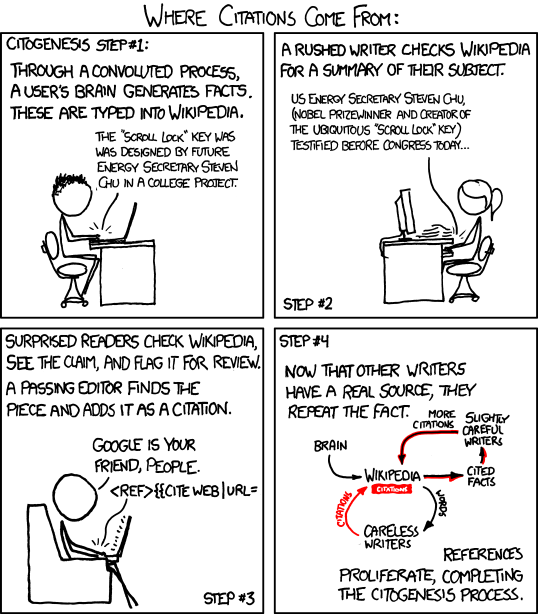
The webcomic XKCD makes great fun of our excessive trust in Wikipedia:

Wikipedia may be useful, but please take its information with a hefty bit of salt.

Friday, October 21, 2011

Why No Theist Should be a Compatibilist


Theologians often ask the question: if God is sovereign over all creation, is it possible for humanity to be free? And if so, how? One of the recent attempts to reconcile divine sovereignty with human freedom is called the compatibilist approach, whereby determinism and free will are considered compatible. This approach is embraced mainly by theologians in Reformed Protestant or Calvinist denominations, such as John Frame and James White. Compatibilism is not the view of Augustine and may not even be the view of John Calvin. I intend to explain why no one who believes in an omniperfect God should ever take a compatibilist view under any circumstances.

The arguments presented here are ripped from Volume 1 of the 2011 Philosophia Christi, which is the trade journal of the Evangelical Philosophical Society. This video will be about free will, which is the view that people are capable of making choices and being held responsible for those choices.

First, let's define our terms:

Determinism - Determinism is the view that all events are governed by laws, which are statements of conditions under which certain effects must occur. For a determinist, Conditions + Laws = Decision.

Simple Indeterminism - Simple Indeterminism is the view that a part of human choice is randomly determined, much like rolling dice or spinning a roulette wheel. Some interpretations of quantum physics view subatomic particles as exhibiting this type of random behavior. For a simple indeterminist, Conditions + Laws + Random Variables = Decision.

Compatibilism - is the view that all events are governed by laws, which are statements of conditions under which certain effects must occur. This is the same definition as determinism, except that the compatibilist believes that such decisions can be considered free choices of which we can be held responsible. For a compatibilist, Conditions + Laws = Decision (which we can call a free choice).

Libertarian Free Will - This is sometimes called self-determinism. Libertarian free will is the position that humans are agents who are able to self-determine some of their behaviors. The libertarian holds that for an action to be free it must be caused by the agent who performs it, and must be done in such a way that no antecedent conditions determine the act. A libertarian agent who makes a choice in a situation could have chosen otherwise, even in the same circumstances. For a libertarian, Conditions + Laws + Agency = Decision.

I will be arguing for libertarian free will and and against compatibilism on two grounds:

1. Reasoning can only be done by an agent with libertarian free will.
2. The problem of evil cannot be resolved without libertarian free will.

One series of arguments against libertarian free will that I have read over the year is the argument that libertarian free will is incoherent or unintelligible. If God exists, then there has to be at least one agent who has libertarian free will, and, presumably, is able to reason. Here's why. Theism is the belief that there is an omniperfect God who is distinct from the physical world, and from all creation. If God did not have libertarian free will, then he would not be sovereign, but would be controlled by outside forces. Hence, one must believe in a God with libertarian free will in order to be a theist. Therefore, no theist can ever argue that libertarian free will is an incoherent idea. That would be inconsistent.

First argument: Reasoning can only be done by an agent with libertarian free will. Compatibilists will argue that reason does not require free will, but can be performed by anything with rational causes. To the compatibilist, what matters is not whether or not you are being controlled (that is a given), what matters is what controls you. If you are pumped full of drugs and it causes you to have a certain set of beliefs, those beliefs are not considered rational. However, if a persuasive philosopher delivers arguments and it causes you to have a certain set of beliefs, that is considered a free and reasonable choice.

One problem with compatibilist theories of reason is that they do not tell why some reasoning belongs to a particular agent. Because compatibilists deny the existence of autonomous agents, they cannot argue that reasoning belongs to an agent if that reasoning comes from that agent's autonomous will. Instead, the compatibilist usually argues that an agent is reasoning if that agent is reasons responsive. This does not really work. A mathematician's notepad may be responsive to the reasoning of a mathematician, and is being controlled by a rational agent. Are we then to say that the notepad is reasoning? A computer is responsive to a rational programmer's instructions, but the machine is not reasoning. Using someone else's reasoning is not the same as reasoning for yourself.

Compatibilists will respond to these types of manipulation arguments by altering their definition of what it means to be rational. They say that subjects are responsible for their decisions when they issue from a mechanism that is moderately reasons-responsive and is also the agent's own mechanism. An agent is moderately reasons-responsive if that agent has two things:
1. A regular pattern of reasons receptivity. This means that the pattern of receptiveness to reasons forms a coherent and intelligible pattern.
2. The agent must at least sometimes act based on his or her best reasons.
A Mechanism is the agent's own if the agent takes responsibility for the mechanism by seeing himself as the one that made the decision.

Suppose Jill, a logic professor and also a neuroscientist who is frustrated with her student Dan, plants a logic chip in his brain. The chip causes Dan to form beliefs based on logic that he otherwise would not have formed himself. For example, if Dan comes into class very tired, and is shown that A=B and B=C, he does not reason that A=C. The chip, however, registering that Dan has A=B and B=C as beliefs, causes Dan to believe that A=C. If the chip caused the belief to form in Dan, can we say that Dan reasoned to that belief? Is Dan responsible for that belief, even though it was caused by the logic chip? Suppose that the logic chip causes Dan to think that he made the decision and that he (Dan) is responsible for praise and blame. Does that even make any difference? I think not. For suppose that Jill programmed an error into the chip, and instead of forming the true belief that A=C in Dan's head, the chip's malfunction causes Dan to believe that A≠C. Can we say that Dan is the one who committed those mistakes? Can we hold Dan responsible for that false belief? The above scenario fulfills all the compatibilist criteria for reason, yet no one would say that Dan is responsible for the beliefs formed by the chip in Dan's head.

Compatibilists may also argue that reasons are causes and that a person's behavior is determined by the best and strongest reasons. If compatibilism is true, and then the bundle of reasons that support a decision must also compel a decision in an irresistible way. However, we know that people do not always make the reasonable decision. People reject conclusions that their best arguments support.

Here is an example: Suppose James came to believe that if reason requires libertarian free will, then compatibilism is false. After reading a number of books, James now believes the antecedent of this argument. He doesn't want to conclude that compatibilism is false, so he converts the modus ponens into a modus tollens. He claims to have learned from the undeniable truth of compatibilism that reason must be redefined so as to exclude the need for libertarian free will. The fact that we can reject a conclusion that our best reasons support is powerful evidence that reasons do not compel a conclusion.

The compatibilist account of reason fails to distinguish between compulsive actions that are occurring within the brain from reasoning that the agent does. Compatibilists have tried to get around it by altering the definition of reason. These new definitions fail because they either attribute reason to inanimate objects such as a notepad, or they deny reason to human beings. Without a distinction between free choices and compulsive acts, there can be no such thing as human reasoning. Compatibilism cannot make such a distinction, and therefore cannot account for human reasoning.

Second argument: The problem of evil cannot be resolved without libertarian free will. The definition of God is "that than which nothing greater can be conceived." God is the metaphysical ultimate, and is by definition an omniperfect being. Such an omniperfect being would be omnipotent, omniscient, and omnibenevolent. Any being that lacks these attributes would be deficient, and therefore would not be God.

The classical objection to the existence of God is called the problem of evil. Evil is by definition a violation of a moral ought, and therefore a deficiency. God is perfect and can have no evil in him, yet our world is filled with evil. How can an omniperfect God co-exist with a non-omniperfect creation? The traditional free will defense of this view, supported by Augustine, has to find some way of severing God's omniperfect desires from the morally imperfect desires of created beings.

Any solution to this problem, short of denying the existence of moral evil, will require that the morally deficient wills of the creatures be autonomous from the omniperfect will of God. If it is better for some creatures with autonomous wills to enter relationship with God than it is for an entire universe to be free of evil, then we may have an explanation as to why evil exists in the first place. The very definition of autonomy restricts which possible worlds are created by God. Such is not in any way a restriction on God's omnipotence, as omnipotence is defined as maximum ability to actualize different states of affairs. To say that God could make an autonomous creature freely choose to act differently than the creature would have acted is as incoherent as saying that God should be able to make a square circle.

Compatibilism, on the other hand, faces one insurmountable obstacle which Jerry Walls calls CI.

CI: If freedom and determinism are compatible, God could have created a world in which all persons freely did only the good at all times.

This world wouldn't just be some logically possible world, uncreatable due to creaturely freedom, but a fully actualizable and creatable world. I will be arguing that any being who would not prefer to create such a world cannot be omnibenevolent. I agree with Antony Flew when he said: "Certainly it would be monstrous to suggest that anyone, however truly responsible in the eyes of men, could fairly be called to account and punished by the God who has rigged his every move. All the bitter words which have ever been written against the wickedness of the God of predestination--especially when he is also thought of as filling Hell with all but the elect--are amply justified." Jerry Walls illustrates this by asking us to imagine the following scenario:

Suppose a preschool is run by a woman who is a master of psychology, neuroscience, and human manipulation. Unbeknownst to their parents, she deliberately conditions the children who attend her preschool. Some of the children she conditions to behave virtuously and live productive lives. Some of the children she conditions to behave in a wicked manner, and sometimes even to become thieves, rapists, and murderers. Let us assume that she succeeds perfectly in her project and each child turns out exactly as she intends.

She avoids detection, and leaves the preschool to go to law school, become a lawyer, and eventually become a judge. One day, a man who once attended her preschool is brought to trial on child molestation charges. Sure enough, overwhelming evidence is brought in, including a confession by the man that he did in fact molest many children. The judge condemns him as a menace to society and sentences him to life in prison with no possibility for parole.

In prison, the man realizes that the judge was his preschool teacher and that she deliberately conditioned him to be a child molester. She could have just as easily conditioned him to be a well-adjusted person and an upstanding citizen. How could we possibly avoid concluding that this woman is evil and directly responsible for the evil acts of these former students? I do not think there is any way. If compatibilism is true, then the situation parallels our situation with God. If humans commit acts of evil, and there is no autonomous will, how can we avoid declaring God evil for making humans act in such a way?

The compatibilist might object that God needs evil to exist in order for him to be maximally great. If we do not sin, how can God show forgiveness? This view makes God dependent on creation in order to be a maximally great (omniperfect) being. If this is the case, then God is dependent on creation, and his creative decree was not a free act, but a necessary act. If God is dependent upon creation, and if his creative decree is not a libertarian free act, then classical theism is false. Such a view is not classical theism, but more of a pantheism, as it closely resembles the theology of Baruch Spinoza.

The compatibilist might fire back that evil needs to exist in order for conscious creatures to appreciate the good. This is nonsense. First, experiencing evil is not necessary to appreciate the good. Otherwise, God himself could not appreciate the good until he experiences evil.

On compatibilism, God is the great puppeteer, and there is no autonomous will. God could either instill with a sense of appreciation anyone who thinks of the good. Another option is for God to hardwire us with an appreciation of the good, the way we are hardwired to believe in other minds, to believe in the reality of the past, and to believe that objects that go out of sight continue to exist when we are not observing them. In either case, God can just make people appreciate the good. Evil is not needed to do that.

In conclusion then, we have two reasons that no one can consistently believe in God and in compatibilism. First, libertarian free will is necessary to account for human reasoning. Second, libertarian free will is necessary to reconcile God's morally perfect will from our morally imperfect wills. Moses Maimonides said that anyone who believes in God must believe in both God's sovereignty and in libertarian free will, even if that person cannot explain how both can be true. It might be explainable, or it might be a divine mystery beyond human comprehension. One thing, however, is for certain. No theist can rationally believe in compatibilism. It simply is not an option for anyone who believes in God.

Saturday, September 24, 2011

Yad L'Achim = Frum Hamas?


I have been reading about anti-missionary terrorist organizations like Yad L'Achim in Israel, who harass and sometimes murder fellow Jews should they ever come to believe in Jesus. If you think about the excuses Yad L’Achim makes for its actions, the reasoning is also pretty ridiculous. It goes something like this:

Messianics are a threat to Israel. Their presence in Israel is a corrupting influence on our society. They come to the area on false pretensions and attempt to Christianize us, undermining our values, our communities, and stealing our children’s souls. We have a right to defend our beliefs and act against those who would destroy them. Their very existence in our land is a threat to us. It would not have bothered us of those Messianics had lived anywhere else, but their encroachment into our territory is an act of aggression and must be stopped by any means necessary.

This sounds familiar for some reason. What happens if we replace Messianics with Jews, Israel with The Middle East, and Christianize with Westernize?

Jews are a threat to the Middle East. Their presence in the Middle East is a corrupting influence on our society. They come to the area on false pretensions and attempt to Westernize us, undermining our values, our communities, and stealing our children’s souls. We have a right to defend our beliefs and act against those who would destroy them. Their very existence in our land is a threat to us. It would not have bothered us of those Jews had lived anywhere else, but their encroachment into our territory is an act of aggression and must be stopped by any means necessary.

Wow. That sounds like the exact same reasoning that Palestinian terrorist organizations use to justify their actions! I guess that explains a lot.

Tuesday, September 20, 2011

Answering Tovia Singer: Was There a Conspiracy?


One of Singer's most effective techniques is his use of conspiracy theory reasoning. Specifically, the central claim of his Let's Get Biblical series is that the New Testament authors deliberately and maliciously changed the Tanakh so that they could paint Jesus into it. Singer also claims that the New Testament writers altered and fabricated events in the life of Jesus in order to strengthen the case for his messiahship, and that the church conspired to cover it all up. Seeing how conspiracy theories seem to be all the rage these days, it is no surprise to me why Tovia Singer is the most successful of the anti-missionaries.

Conspiracy theorists make heavy use of three techniques:

Technique #1. Arguing from coincidence. Conspiracy theorists love to exploit the phenomenon called pareidolia. Pareidolia is what happens when our minds impose patterns on randomness. Ink blot tests are an example of this, so is our tendency to see faces in rocks, trees, and clouds. Did a politician cancel a flight at the last minute, right before a disaster such as 9/11? There are a lot of politicians and they tend to travel a lot. Flight cancellations are not that uncommon, so it could be a coincidence. But not if you're a conspiracy theorist! No. That cancellation is proof positive that the politician is deeply involved in an elaborate conspiracy of evil masterminds!

Technique #2. Use of explanatory gaps as proof of their theory. Conspiracy theorists recognize that almost any explanation will have "errant data" i.e. facts or alleged facts that do not fit the official explanation. Errant data are the currency of conspiracy theorists, the proof that their pet theory is correct. The problem with this technique is that it often fails to properly weigh the criteria for justifying historical explanations.

The fact that a conspiracy theory perfectly fits all the errant data, and fills all the holes left by the official explanation is not in itself proof, or even strong evidence that the theory is correct. Explanations are judged by a wide range of criteria, primarily the ability to explain future discoveries. Other criteria include the ability to imply other statements describing present, observable data, as well as how ad hoc the explanation is (it must include fewer new suppositions which are not already implied to some extent by existing beliefs). Conspiracy theories tend to have strong explanatory scope, but also tend to be very ad hoc, or contrived.

Technique #3. Exploiting the audience's ignorance. I love speakers who ask questions. It helps to engage the audience. It makes the audience feel they are part of a two-way dialogue. It helps the audience take interest in the subject, and feel that they are the ones arriving at the speaker's conclusion. All of this is good. What is not so good is when a speaker abuses this technique to derive his or her own conclusions from the often ill-informed assumptions of the audience members.

Here is a series of errors that conspiracy theorists often make, all of them ripped from Dr. Jeremy Goodenough of the University of East Anglia.

Error #1. Moving from the accepted fact that X once lied to the belief that nothing X says is trustworthy. This is a favorite of Holocaust deniers. If there is just one demonstrable mistake in for instance a witness statement, the whole statement is rejected as a forgery. The deniers argue that since there are several historical interpretations of the Holocaust, therefore it never happened. In other words: If one historian suggests that only 4 million Jews fell victim to the Nazi persecution, and another historian suggests 7 million, it means the Holocaust must be a false construction.

Error #2. An inability to make rational or proportional means-end judgments. Conspiracy theorists argue that some group of conspirators has been acting to further some aim or to prevent some action taking place, but often fail to ask whether such a group of conspirators could further their aim in some easier or less expensive or less risky fashion.

Error #3. Treating evidence against the theory as evidence for it. Conspiracy theorists do not just argue that the evidence could point toward a different conclusion. Rather, they claim that the evidence supporting the official verdict is suspect, fraudulent, faked or coerced. And because this fraudulent evidence exists, that further proves that the conspiracy theory is right!

Error #4. The classic logical fallacy of post hoc ergo proper hoc (after this, therefore because of this). The conspiracy theorist claims that because event B occurred after, or even as a result of event A, therefore, event A was caused to bring about event B. For example: The First World War happened after the death of the Archduke Franz Ferdinand, and there is clearly a sense in which it happened because of his death: there is a causal chain leading from the death of the Archduke to the first World War. Though these effects of the assassination may now appear obvious, that is no indication that such a progression was obvious to the people involved in these events at that time. There is no evidence that the people who assassinated the Archduke had any clue that it would bring about a world war. Hindsight is overwhelmingly clearer than foresight.

We observe these techniques and errors all the time in Singer's tape series. For example, he commits error #1 when he argues that the New Testament accounts contradict each other in certain details, and therefore cannot be trusted to represent history. Quite the contrary. Livy and Polybius give two irreconcilable accounts of Hannibal's campaign as he crossed the Alps and invaded Rome. Yet no historian doubts that Hannibal did mount such a campaign.

Singer dismisses the Septuagint as a church invention. Singer claims as his evidence that that in the book of Acts (Acts 7:14, to be exact), Stephen described the entrance of the patriarchs into Egypt, but Stephen got the number wrong, claiming that seventy-five souls went down from Canaan to Egypt rather than 70, which is stated by the Masroetic text in Genesis 46:27, Exodus 1:5, and Deuteronomy 10:22.

Singer then makes the claim that the church altered the Septuagint so that the text in those three locations would fit Stephen's speech! The Septuagint, or at least the Pentateuch, was translated from Hebrew into Greek under Ptolemy Philadelphus around 250 years before the birth of Jesus. Singer claims that the church changed the numbers to cover Stephen's error. How does he deal with the fact that the Septuagint still reads seventy souls in Deuteronomy? Obviously the church blundered when the altered the text and missed it. How is it we have no manuscript evidence of the alleged tampering, such as ancient fragments that read "seventy" in all three places? The church was powerful and thorough in covering its tracks.

This argument utilizes technique #2, where Singer concocts his elaborate tale of fraud and conspiracy. He then goes to the text to imply that the textual evidence perfectly fits his theory's predictions. In reality, he looked at the differences in the texts, and contrived a story to fit. In his argument, Singer commits errors #2 and 3. It would be a lot easier for the church to cover Stephen's alleged error by altering his speech in the book of Acts, over which the church had far greater control than it had over the Greek Pentateuch. He also paints the church as an entity crafty, organized, and powerful enough to obliterate all manuscript evidence of its alterations, and yet careless enough to forget to alter Deuteronomy.

By the way, the Dead Sea Scrolls at Qumran agree with the Septuagint, so Stephen might have been quoting a variant of the text. Regardless, Singer's explanation is one of the Rube Goldberg variety. It is woefully and unnecessarily fanciful.

One of the best ways to prepare yourself for dealing with people like Tovia Singer, is to learn the methods and fallacies behind conspiracy theorists by reading the articles in the links below:

A Quick Introduction:
http://www.fontcraft.com/idiotwars/?p=8

A List of Conspiracy Theorist Fallacies:
http://warp.povusers.org/grrr/conspiracytheories.html

Critical Thinking About Conspiracies (long, but worth it):
http://www.uea.ac.uk/~j097/CONSP01.htm

Monday, August 29, 2011

Answering Tovia Singer: Did God Create Evil?


In page 395 of his study guide, Let's Get Biblical, Tovia Singer answers a question about the Rabbinic doctrine of Satan. The questioner asks how a God who is good and holy can possibly be the author of evil, not just in the sense of allowing for evil to exist, but in the sense that God actively creates evil.

Singer responds that God placed both good and evil into the world. He cites two verses the first is Deuteronomy 30:15 which states:

"See, I [God] have set before thee this day life and good, and death and evil."

The second is Isaiah 45:7 which states:

"I form the light, and create darkness; I make peace, and create evil; I the Lord do all these things."

Singer then goes on to attack Christian doctrine.
The two verses, Isaiah 45:7 and Deuteronomy 30:15, however, pose a serious theological problem for Christians who maintain that God did not create Satan, the angel of evil. According to Christian doctrine, as you suggest in your question, Satan was the highest-ranking angel who, through is own act of spiritual defiance and outright disobedience, became the chief adversary and slanderer of God and the embodiment of evil in this world. In Christian theology God never created evil; He is only the author of righteousness and perfection, as you maintained in your question. Therefore, God could never create something as sinister as the devil himself. Rather, Satan's unyielding wickedness is the result of his own spiritual rebellion.

Singer then compares the Christian view of good and evil to the dualism of Zoroastrianism, where the God Ahura Mazda has two equal manifestations, Spenta (good) and Angra (evil). Singer then states that angel means "messenger," and that no angel in the Tanakh ever opposes God's will, Satan included.

Singer then mentions the book of Job, where Satan appears before God to test the faithfulness of Job. God allows Satan to do so as long as the latter does not kill Job. According to Singer "Satan obediently follows his Creator's instructions" a statement which implies that God actually ordered Satan to torment Job, rather than giving Satan permission. Then Singer states:

Still, by the end of this unparalleled biblical narrative, Job's virtue prevails over Satan's unyielding torment. While in Christian terms Job's personal spiritual triumph is a theological impossibility, in Jewish terms it stands out as the embodiment of God's salvation program for mankind.

Singer then goes on to attack the NIV translation as a skewed understanding that conceals Isaiah's original message in order to preserve a Christian doctrine that contradicts what the Jewish scriptures so clearly teach.

I have to give Rabbi Singer points for rhetoric. When read by an average individual, his argument implies that the NIV translators deliberately mistranslated Isaiah 45, that Deuteronomy 30:15 states that God actively creates evil (and therefore we have two passages to support the claim instead of merely one verse), that the King James translates Isaiah 45:7 as moral evil, and that God actively ordered Satan to torment Job. When pressed by an apologist on these claims, Singer can rightly say that he never explicitly stated any of them. Pretty clever, huh?

First off, a little background about the book of Job. Christian theology does not state that God and Satan are in any way equals or counterparts. All angels, including Satan, are inferior created beings who are as helpless to resist God's omnipotence as we are. This is why Satan has to ask permission in order to torment God's servant Job.

The narrative then continues where Satan destroys Job's entire estate, kills his family, and if that was not enough, inflicts plagues and illnesses upon the poor man. Job's friends try to comfort him by offering Job a theodicy, an explanation as to why a good God is allowing Job to suffer.

After Job continues to complain, God finally appears, rebukes Job and his friends, and then tells Job that God does not owe anyone an explanation to why they suffer. We do not have God's vast perspective and extraordinary knowledge. We were not there at the creation of the world. We are weak, short-lived creatures who may not even be able to comprehend God's reasons for his actions.

The focus of Job is the problem of evil. The fact that we have no explanation for why a good God allows evil to exist and may never have such an explanation does not in any way indicate that there is no explanation.

God does restore Job's fortunes at the end of the book, but there is no indication that this is a reward for Job's faithfulness. In fact, it probably isn't, considering what Job says at the beginning of the chapter:

“I know that you can do all things,
and that no purpose of yours can be thwarted.
‘Who is this that hides counsel without knowledge?’
Therefore I have uttered what I did not understand,
things too wonderful for me, which I did not know.
‘Hear, and I will speak;
I will question you, and you make it known to me.’
I had heard of you by the hearing of the ear,
but now my eye sees you;
therefore I despise myself,
and repent in dust and ashes.”

(Job 42:2-6)

In Deuteronomy 30:15, the text seems to indicate that Israel is given two options: be faithful, loyal and good, and you will have life and prosperity. Be apostate, disloyal and evil, and you will have death and ruin. Where is the indication that God actively created evil? I can't find any, but maybe Tovia is drawing his ideas from the Rabbinic tradition. What does said tradition say about this verse?

R'Yochanan said of this verse: From the day that God made this declaration, goodness and evil did not emanate from His mouth; rather, evil comes of its own accord to one who does evil, and good comes to one who does good.

What about Isaiah 45:7 where God states that he creates evil? The word "evil" has more than one meaning, and those alternate (non-moral) meanings were in greater use during the time that the King James Bible was written. I was curious which definition of evil Tovia meant in this context. Here are five definitions of evil I found in the dictionary.

1. that which is evil; evil quality, intention, or conduct: to choose the lesser of two evils.
2. the force in nature that governs and gives rise to wickedness and sin.
3. the wicked or immoral part of someone or something: The evil in his nature has destroyed the good.
4. harm; mischief; misfortune: to wish one evil.
5. anything causing injury or harm: Tobacco is considered by some to be an evil.

Is this talking about evil in a moral sense, or in one of the non-moral senses? Let's look at the Hebrew to see if it helps us:
יֹוצֵר אֹור וּבֹורֵא חֹשֶׁךְ
עֹשֶׂה שָׁלֹום וּבֹורֵא רָע
אֲנִי יְהוָה עֹשֶׂה כָל־אֵלֶּה


Forming light and creating darkness
establishing peace and creating ra,
I, the LORD create all these
The word in question is: רָע (ra, Strong's H7451) which can mean bad, evil, distress, misery, injury, or calamity. Basically, it's the same as our English word "bad" and carries a lot of the same meanings. Which meaning? Let's look at the context. The verse features two parallel lines, each line comparing two opposite ideas. God creates light, and its opposite, darkness. God establishes peace, and its opposite, chaos.

The next question is: is this just my interpretation, or is there Rabbinic support of this? I found one comment from Redak in the Judaica Press Tanach, who stated that in this context, רָע means "the opposite of peace, war with Babylon." Redak seems to indicate that this isn't a statement that God creates moral evil, but a statement that God creates peace and breaks peace, or that he both calms and agitates.

Oh, I almost forgot. Singer complains that some Christians believe Isaiah 14:12 is about Satan. I will admit that the oracle delivered by Isaiah is addressed to Nebuchadnezzar, but there is one part of this oracle that seems different:

How you are fallen from heaven,
O Day Star, son of Dawn!
How you are cut down to the ground,
you who laid the nations low!
You said in your heart,
"I will ascend to heaven;
above the stars of God
I will set my throne on high;
I will sit on the mount of assembly
in the far reaches of the north;
I will ascend above the heights of the clouds;
I will make myself like the Most High."
But you are brought down to Sheol,
to the far reaches of the pit.

(Isaiah 14:12-15)

I'm not sure if you can apply this to Nebuchadnezzar. What pagan king, after all, tried to supplant God's rule over heaven, only to fall from it?

Sunday, August 28, 2011

Answering Tovia Singer: An Introduction


Today, we begin our answering the anti-missionaries series. I intend to focus on specific anti-missionaries, give their backgrounds, and show you their arguments and rhetorical tricks, so that you can better debate them.

Perhaps the most famous anti-missionary is Tovia Singer. He is a charming and charismatic speaker, sort of the Rabbinic version of Ahmed Deedat. Neither is much of a scholar, but both are fantastic showmen, able to stir up crowds with their golden-tongued rhetoric.

I heard from a Messianic Rabbi who apparently was a long-time friend of Rabbi Singer, that Singer at one point in his life almost became a Messianic Jew. After rejecting this option, its seems that Singer decided to pursue a career to keep his fellow Jews away from Jesus at any cost. He is now the director of Outreach Judasim. He has his own radio show in Israel and his own tape series and study companion, both titled Let's Get Biblical.

As Michael Flanigan gives in his testimonial for Singer's book: "Check all the references to Strong's Driver and Briggs, or any other resource you have." I couldn't agree more. Two resources I recommend for a more in-depth study are biblos.com which has the Bible in almost every conceivable language, interlinear versions, and Strong's numbers for further research. The other is the Blue Letter Bible, which gives you access to word study tools. Both are completely free, and don't even require you to register!

In fact, I recommend that every Biblical apologist go through Singer's material with a Bible study group. Nearly all the apologetics disasters come from Lone Ranger apologists.

That said, go slowly through Singer's tapes and his study guide and thoroughly research answers to his objections. This will take a lot of time, a matter of years. Be patient and keep plugging along, because if you can finish this monstrous series, you will be prepared to obliterate almost any Biblical skeptic in debate.

For the rest of you who do not want to engage in such a humongous chore, you can just cheat. James Trimm has released an audio series with a lot of the answers to Singer's objections in his Let's Get Truthful audio series. Michael Brown has also released his own audio series called Countering the Counter-Missionaries. He also gives even more detailed responses in his five volume book series Answering Jewish Objections to Jesus.

My series will not attempt to provide any sort of an exhaustive answer to Tovia Singer's objections, which may at first glance seem overpowering, but take heart. Singer is a powerful speaker, but a weak Biblical scholar who makes a lot of basic errors. I intend to not only expose some of his errors but I also intend to bring something unique to the table: an explanation of how Tovia uses his rhetorical skills to make a relatively weak argument sound much, much stronger than it actually is. So yes, Tovia. Let's get Biblical.